
Writing a Report
Cambridge English: C1 Advanced
What the heck is a report?
A report is an informative piece of writing which explores and summarises some research and which may end with recommendations for future actions. Like critical essays, reports have their own formal sections and standard structure. … Developing the principles of good report writing will help you to communicate well in whichever career you choose.
Who do we write a report for?
We usually write a report for a superior (e.g. a boss or college principal) or a peer group (e.g. club members or colleagues).
Content
A report task normally requires you to provide information about a situation in the present or past. You may also be asked to suggest a future course of action.
Always begin by stating the purpose of your report (basically, just paraphrase the task in the introduction).
Use invented statistics to provide a summary of your results.
NOTE: In case you need to include recommendations, each problem you mention in the body of the report needs to be addressed in the recommendations section.
Organisation
One of the most important characteristics of a well-written report is that it has a clear layout. Each paragraph should have its own short heading. Of course, we need to make sure that the headings reflect the content of the paragraphs.
We should always name the first paragraph Introduction, and the last one Recommendations. If the task doesn’t ask for recommendations, the last paragraph should be named Conclusion.
Use bullet-pointed list in only one of the paragraphs; I suggest you do this in the recommendations.
Language
Make sure you write in formal and impersonal style: avoid “I” and “you”; avoid contractions (isn’t); use passive and impersonal passive (It has been suggested that…)
Use a variety of sentence structures and try to include rich academic vocabulary.
Useful Phrases for Report Writing
INTRODUCTION
The principal aim of this report is to provide a description of…
The purpose/objective of this report is to present results of…
In this report I shall assess the importance of…
This report provides an assessment of…
The final section makes recommendations for…
DESCRIBING HOW YOU OBTAINED THE INFORMATION
I conducted interviews/a survey with (all current members of…)
I visited one of the most popular restaurants in the area and interviewed…
Following discussion among the (staff), it has become clear that…
REPORTING RESULTS
Most of those responding to the survey stated that/expressed the opinion that…
According to one interviewee, (Mr Pitt), the traffic problem is…
50% of the informants feel that…
A significant/considerable proportion of those surveyed/respondents/informants said that…
Nearly three quarters of the (shop keepers) had seen an improvement in the situation.
PRESENTING A LIST
The arguments against (something) are the following: …
The following were the main reasons given for supporting (something): Firstly,… Secondly,…
Points our informants mentioned in favour of/against the scheme were: …
RECOMMENDATIONS
In light of the results above, I would make the following recommendations:
1 One possible solution would be to…
2 Another course of action might imply…
3 I have no hesitation in suggesting that…
CONCLUSION
Should these recommendations be implemented, (e.g. the current situation is bound to improve).
Taking all the factors mentioned into account, (…) would appear to be the most viable solution/option/approach.
I would therefore recommend the immediate implementation of the scheme.
Exam Task:

Model Answer:
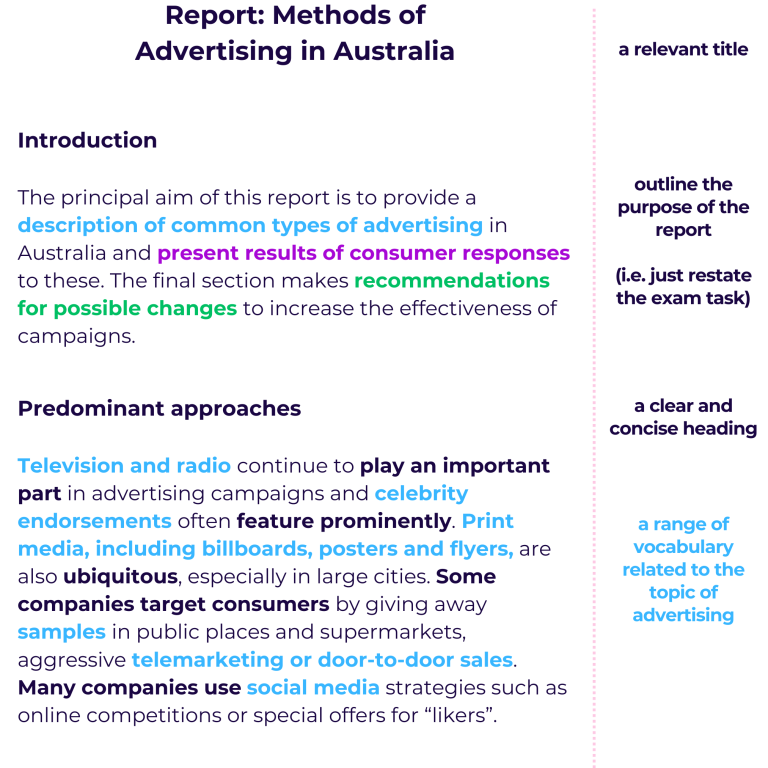

Let's recap. A good report should:
- have a clear layout
- clearly differentiate paragraphs with headings
- have a clear introduction giving the basic facts
- use neutral or formal language (vocabulary and structures)
- present information objectively, although it may then lead to a more personal conclusion